

Introduction
Background
IGNITE CSOs (2024-2026) stands for Improving Governance, Networking and Inclusivity Towards Empwered Civil Society Organisations, and is led by The Cropper Foundation (TCF), with support from Veni Apwann (VA) and is funded by the European Union.

IGNITE CSOs aims to enhance the capacities, policy engagement opportunities and the legislative environment for CSOs, towards a more inclusive, participatory, empowered, and independent civil society in Trinidad and Tobago.
The action is implemented along 3 Pathways:
- Pathway 1: Enhancing the Legal and Fiscal Enabling Environment for CSOs
- Pathway 2: Sustainable and Recognised Capacity Building (led by VA)
- Pathway 3: Building a Distributed Value Network for CSO Resources
The objectives of Pathway 2 are to develop a nationally recognised accountability framework and related micro-credential programmes, co-designed by CSOs and national expert associations, also referred to as professional organisations (POs), and provide training with nationally recognised certification.
In principle, CSOs have a general appreciation for the need for increased levels of accountability throughout the Sector.
However, the ability for CSOs to adhere to acceptable industry standards is stymied by many factors, including a lack of adequate human and financial resources.
Why a National Accountability Framework?
The Civil Society Sector of Trinidad and Tobago is a critical national development partner, along with the Public and Private Sectors. Securing the Sector’s long-term sustainability is essential to our country’s future and citizens’ well-being.
Who is a CSO?
It’s easy to be confused by the term ‘CSO’, given the many labels and categories of organisations applied to entities within the Sector by government, donors, and even us! So, before going any further, let’s get a clearer idea of who is considered a Civil Society Organisation.

Above: The diverse typologies and designations applied to CSOs.
According to the United Nations, a civil society organisation (CSO) is any non-profit or voluntary citizens’ group organised on a local, national or international level. Task-oriented and driven by people with a common interest, CSOs perform a variety of services and humanitarian functions, bring citizens’ concerns to Governments, monitor policies, and encourage political participation at the community level. [1]
Now that you know we are speaking to you, let’s continue with the rationale for making ‘being accountable’ one of your organization’s highest priorities!
Demonstrating the highest levels of accountability is key for the Sector’s sustainability within the national legislative environment.[2] Accountability is a cornerstone of effective and sustainable CSOs. It ensures that these organisations remain true to their missions, maintain trust with stakeholders, and deliver impactful services.
To systematically achieve these results, CSOs must integrate accountability measures throughout their organisations, ensure every member of their organisation, whether paid or volunteer, embrace their individual responsibility to be accountable, no matter what task they take on. Accountability must be demonstrated on an ongoing basis to ensure sustainability.
An accountability framework – which integrates the local context, legal requirements, and cultural factors – provides a structured approach for CSOs to demonstrate responsibility, transparency, integrity, and effective governance.
Here’s a table further outlining the benefits of civil society accountability and the consequences of its absence:
Benefits of Civil Society Accountability | Consequences of Lack of Civil Society Accountability |
Promotes Transparency – Ensures organisations act openly and honestly, reducing corruption and misinformation. | Increased Corruption – Lack of oversight can lead to unethical practices and misuse of resources. |
Enhances Public Trust – Citizens are more likely to support and engage with organisations that operate responsibly. | Erosion of Public Confidence – People may lose faith in institutions that act irresponsibly or dishonestly. |
Encourages Responsible Governance – Holds authorities and organisations accountable for their actions and policies. | Weak Governance & Poor Decision-Making – Leaders may act in self-interest rather than for the public good. |
Boosts Civic Engagement – Encourages people to participate in social and political matters, leading to positive change. | Public Disengagement & Apathy – Without accountability, people may feel powerless and disengaged from governance. |
Strengthens Democracy – Ensures fair processes and decision-making, preventing abuse of power. | Threat to Democratic Institutions – Weak accountability can result in authoritarian tendencies and erosion of rights. |
Protects Human Rights – Upholds justice, equality, and protection for vulnerable groups. | Increase in Human Rights Violations – Marginalised communities may suffer from unchecked discrimination or injustice. |
Encourages Sustainable Development – Helps ensure long-term, fair distribution of resources. | Unbalanced Growth & Social Inequality – Resources may be exploited without regard for future generations. |
Civil society accountability plays a crucial role in shaping fair and ethical societies. When it is lacking, the negative consequences can ripple through communities, affecting governance, trust, and social well-being.
As one NAF consultation participant indicated, society-wide corruption, lack of integrity, and avoidance of accountability have long plagued our twin-island Nation. Karl Hudson-Phillip, 13 years ago, at the 2012 annual general meeting of the Trinidad and Tobago Transparency Institute (TTTI), referenced parts of a speech he intended to give 40 years prior, on corruption. Hudson-Phillips was quoted as saying, “What is required is a new resolve — a moral rearmament of both old and young. We must insist on proper standards of conduct at all levels,” Hudson-Phillips lamented the perception in the country that corruption had become systemic.
“The population is now being assaulted by the revelations of unprecedented corporate greed and institutional incompetence. The idea of fiduciary responsibility appears non-existent.”[3]
With the rationale for the need for a National Accountability Framework (NAF) embraced by most consultation participants, there was a call to ensure information about the NAF reached as many CSOs as possible, and that the effectiveness of its implementation within civil society is monitored. Ideas floated for achieving these objectives included partnering with the Registrar General’s Department and the (then called) Ministry of the Attorney General and Legal Affairs, and hosting gatherings such as the 2026 edition of ‘World NGO Day’ to benefit as many CSOs as possible.
This NAF will focus on 4 management and operational areas:
- Governance,
- Project Management,
- Financial Management, and
- Human Resource Management.
Methodology
VA developed the NAF in collaboration with the Capacity Building Working Group (CBWG) comprising CSOs, Professional Organisations (POs) and the NGO Unit from the (then called) Ministry of Social Development and Family Services. (See Appendix 1)
The process involved:
- Desk review of existing CSO accountability documents inclusive of organisational self-assessment instruments.[4]
- Review and adaptation of globally recognised industry standards provided by the POs.
- Eliciting stakeholder feedback via a public consultation hosted by TCF and facilitated by VA (World NGO Day 2024).
- Raising awareness of the importance of the NAF to the Sector and encouraging buy-in for Sector-wide implementation.
- Hosting country-wide, in-person and online public consultationsto elicit stakeholder feedback to inform the development of the NAF.
How to Best Use the NAF
Each CSO has its particular nuances and realities that affect how it operates. When using the NAF, consider your alignment with the proposed core principles, practices and expected outcomes while taking into account what can realistically be implemented in your organisation. Some practices may not apply to your CSO.
The ultimate objective is to increase the level of professionalism with which your organisation conducts its business. The NAF can actively be used as an instrument against which to measure your progress towards that objective, at a pace that makes sense for you and your team.
Principles [5]
Accountability is a globally recognised governance principle that ensures that an organisation’s leaders are held to the highest standards expected of them.
Governing bodies that are held to account, perform at their best, and exercise proper oversight over those to whom they have delegated responsibility.
Principles of accountability are the core values that underpin what it means to be accountable.
- Integrity and Transparency: Upholding social and ethical norms and values; being open, honest and trustworthy; without consideration for personal gain and staying true to the social mission
- Effectiveness and Efficiency: Doing the right thing and doing it right! Ensuring that staff and volunteers are qualified and continually update their knowledge.
- Orientation to Learning and Knowledge Sharing: Commitment to continuously develop and update professional skills of all stakeholders.
- Systems Thinking: Taking a holistic view of how project parts interact with each other and external systems.
- Objectivity: Decisions should be made without bias, avoiding conflicts of interest.
- Responsiveness/Orientation to Change: Remains positive and effective in response to change; adapts to new methods and structures; thinks outside the box; handles ambiguity.
- Inclusion and Sensitivity to Diversity: Treats all individuals and groups fairly and with respect.
- Confidentiality: Safeguarding sensitive information related to internal and external stakeholders.
- Compliance: CSOs must comply with laws and regulations while avoiding actions that could discredit the organisation.
- Stakeholder Orientation: Informed by a stakeholder-centric focus.
- Collaboration: #StrongerTogether
- Value Creation: Value is the ultimate indicator of project success. A focus on outcomes allows project teams to support the intended benefits that lead to value creation.
Key Practices
Standards of accountability are more prescriptive than principles and detail the specific actions a CSO should take to put accountability into practice.
Governing Body Accountability
Governing bodies (i.e. Boards of Directors, Executive Committees or Trustees) should prioritise business ethics, corporate responsibility, social mission and integrated thinking to balance current and future needs in the interest of the long-term sustainability of the organisation.
Members of the governing bodies should be independent in character and judgment as well as apolitical.
- Board Responsibilities
- Maintain oversight of the organisation.
- Be accountable to the organisation, its employees, clients, and other stakeholders for the organisation’s performance and how it conducts its business.
- Adequately constitute, train and support the governing body.
- Drive the organisation’s sustainability and enduring value creation.
- Create policy.
- Define clear roles and responsibilities for board members to oversee strategic direction and fiduciary responsibilities.
- Implement regular self-assessments and external evaluations of governance practices.
- Stakeholder Engagement
- Identify and prioritise stakeholders.
- Facilitate active participation of members in decision-making processes.
- Actively engage stakeholders, ensuring representation of marginalised voices, and conduct regular meetings to discuss strategic goals and achievements, financial performance, organisational sustainability, and value creation.
- Collaborations and Partnerships – Foster transparent relationships with other CSOs, government entities, and private sector partners.
- Legal and Ethical Compliance
- Ethical Standards and Guidelines
- Develop and enforce ethical guidelines regarding confidentiality, data protection, and beneficiary rights.
- Code of Conduct
- Establish codes of conduct for leadership to model integrity and ethical behaviour. One excellent regional initiative is the Caribbean Policy Development Centre’s NGO Code of Conduct. We encourage you to sign on![6]
- Adherence to Local Regulations
- Stay informed about and compliant with the relevant legal framework governing CSOs in Trinidad and Tobago, including registration requirements and compliance with the Companies Act 1995 or Non-Profit Organisations Act 2019.
- Regulatory Reporting
- Ensure timely submission of required reports to regulatory bodies (e.g., Ministry of the People, Social Development and Family Services).
- Ethical Standards and Guidelines
- Crisis Management and Response
- Develop risk management plans that identify potential risks and create mitigation strategies.
- Prepare crisis communication plans for transparent communication during crises to maintain trust.
- Policy Development, Implementation and Review[7]
- Board/Governance
- Human Resource Management
- Financial Management
- Wholeness and Justice Programme (as in the case of local non-profit CAISO)
- IT Security Programme
- Remote Work
- Communication and Reporting
- Ensure that information about the organisation’s work is accessible and understandable.
- Provide consistent updates on project progress, challenges, and achievements.
- Create channels for stakeholders to provide input and express concerns.
- Transparency
- Public Disclosure
- Prepare and disseminate annual reports, including financial statements, activities, and impact assessments.
- Make governance documents (e.g., bylaws, meeting minutes), information about governance structures and decision-making processes accessible to stakeholders.
- Public Disclosure
- Reporting and Accountability Mechanisms
- Regular Reporting
- Establish a schedule for consistent internal and external reporting on performance, challenges, and progress towards goals.
- Public Accountability Forums
- Organise community fora to discuss the organisation’s work and gather input from stakeholders. In the Caribbean, we have a strong heritage of coming together in creative and participatory ways to address the issues that impact our lives. One such method is the Gayap.[8]
- Utilise platforms like social media, websites, and newsletters to keep stakeholders regularly informed about organisational developments.
Financial Accountability
Budgeting and Financial Planning
- Develop and approve annual budgets that align with strategic goals and ensure clarity in funding sources.
- Annual budget approved by the board with justification for allocations
- Develop participatory budgeting that includes input from relevant stakeholders.
Sustainable Practices
- Pursue funding strategies that promote long-term sustainability.
- Review organisational performance against determined criteria and take corrective action to arrest and reverse declining financial performance and results.
- Asset Management: Maintain accurate records and safeguard organisational property and resources.
Transparency in Financial Reporting and Management
- Have a chartered accountant conduct annual external audits[9] and implement subsequent audit recommendations.
- Ensure financial reports/management accounts are timely, accessible, and understandable to stakeholders.
Generating and maintaining relevant data
- Create and maintain time logs.
- Record in-kind donations.
Donor Accountability
- Respect donor intent and provide transparent reporting on the use of funds.
- Implement a Fund Accounting System where necessary.
Resource Mobilisation and Management
- Know Your Donor – do due diligence on potential and current donors to mitigate against being used as channels for Terrorist Financing and Money Laundering.
Good Financial Management contributes to improved resilience and long-term sustainability
How?
- Compliance with Companies 1995 and NPO 2019 Acts leading to reduced to nil reputational risk and enhanced donor, stakeholder trust in the organisation
- Improved funder/donor protection and confidence
- Increased access to financing
- Improved stewardship, oversight, and accountability
- Improved risk management
- Improved monitoring and evaluation
Programme/Project Accountability
- Monitoring and Evaluation
- Set up systems to measure program outcomes and impact effectively.
- Establish clear performance indicators for all programs and initiatives for measuring success.
- Conduct regular assessments to evaluate program effectiveness and impact.
Stakeholder Engagement
- Involve beneficiaries and partners in program design and evaluation.
- Feedback Mechanisms
- Create channels (e.g. surveys, community fora) for beneficiaries and stakeholders to provide feedback on programmes.
- Address concerns and suggestions promptly.
- Respond to feedback with actionable changes where necessary.
- Adaptability
- Utilise feedback mechanisms to adapt programs to changing needs and contexts.
Human Resource Accountability
Efficient and Functional Human Resource Management aids the workforce of a CSO to contribute effectively towards the overall achievement of the organisation’s goals.
At the strategic level, four areas of key HR practices are:
- Developing an HR Strategy that:
- Aligns with vision, mission and goals;
- Informs policy approval;
- Is updated on employment trends and compliant with labour laws;
- Promotes diversity and inclusion in hiring.
- Fostering Collaborative Relations towards:
- A collaborative culture, monitor partnerships, remove barriers to cooperation, and forge new external collaborations;
- Ensuring balance between employees’ and employers’ understanding that they both have rights as well as responsibilities;
- Ensuring employers cannot ignore unions. There will be times when employers will need to seek redress from unions. Therefore, maintaining good relationships with the unions is key.
- Creating respectful and motivating workspaces/cultures to:
- Shape a culture that values and benefits from diversity;
- Create a learning environment, positively encourage individuals to learn and personally coach staff members;
- Model honesty and integrity, uphold ethical standards and the CSO’s values in everyday behaviour;
- Build a member-centric culture by actively seeking feedback and monitoring satisfaction, and taking prompt action to address dissatisfaction;
- Ensure that the members’ commitments are fulfilled;
- Recognise opportunities for change, encourage others to instigate change, drive change positively, and address change resistance;
- Build a performance culture;
- Stress the importance of quality, establish quality processes, ensure that resources support quality delivery, and build mechanisms to monitor quality;
- Create transparent, career development-oriented, and merit-based recruitment and promotion processes.
- Engaging in proactive Fund Development to undergird a robust HR Strategy to:
- Secure resources required to support staff development.
At the operational level, key practices related to the individual include:
- The development of policies for alternative working arrangements;
- Data protection in the growing AI context;
- Merit and career development-based recruitment and promotion processes:
- Documented and transparent performance management cycles including evaluation processes for staff performance
- Regular reflection sessions to learn from successes and failures/challenges;
- Active participation in continuous learning activities inclusive of accountability, governance, ethics;
- Implementation of best practices;
- Positive approach to change – treats change as an opportunity, focuses on the benefits of change, accepts new ideas and change initiatives;
- Alignment of behaviour with values;
- Embracing responsibility – takes independent action, responds quickly, goes above and beyond, is motivated to perform;
- Openness to all views and opinions, including those that differ from one’s own;
- Building member-focused solutions;
- Clear communication;
- Integration of tools for planning, organisation and structure – sets detailed plans, anticipates and prepares for problems;
- Network building;
- Commitment to compliance – safeguards against potential legal troubles (requires knowledge of labour laws and a safe working environment.
Operational HR Best Practices are very relevant in the Civil Society Sector but may be hindered because:
- Opportunities for promotion may be limited;
- HR practices within civil society are directly influenced by project funding cycles. Proactive fund development can mitigate potential obstacles, e.g. accessing 100% subsidised On-the-Job Trainees;
- Most CSOs have no health or pension plans in place. Collective CSO pension plans, which allow for group rates, may present a viable alternative.
Good HR Management Leads to Improved Resilience and Long-Term Sustainability
How?
- Achievement of Mission and Goals
- Positive Organisational Brand
- Employee Buy-in and Loyalty
- Talent Management and Growth
- Proactive Conflict Management
- Individual and Organisational Role Modelling
Implementation Strategies – ‘Steps to Success’
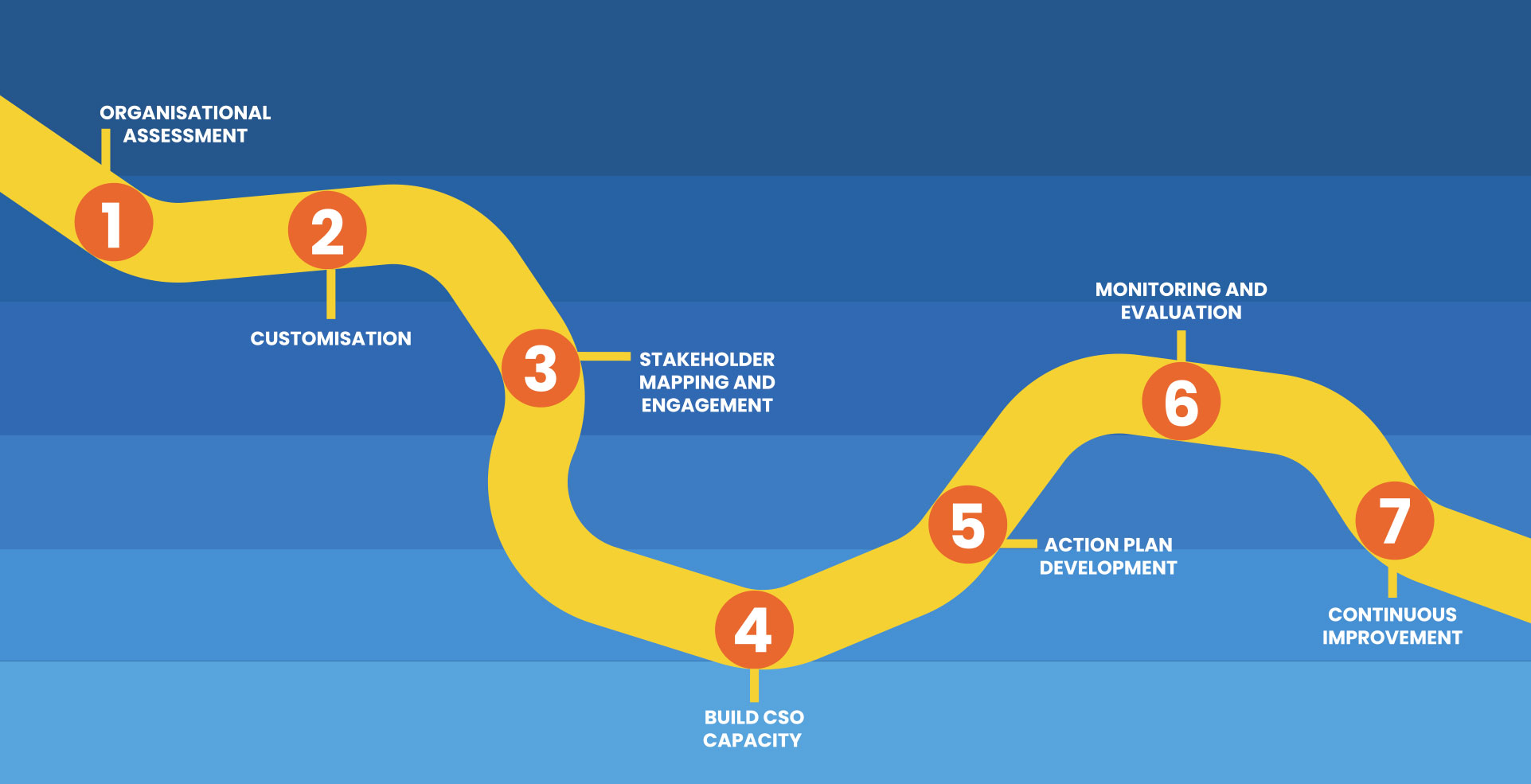
Above: Seven-Step Implementation Pathway
Assessment of Organisation’s Accountability
Evaluate the organisation’s current practices against the accountability framework to identify strengths and areas of improvement.
Customisation
Guided by the results of the Self Assessment, determine your CSO’s priority areas for improvement.
Stakeholder Mapping and Engagement
Stakeholder Mapping: Identify all stakeholders, including beneficiaries, donors, staff, and partners.
Stakeholder Engagement: Involve stakeholders in the implementation process to ensure buy-in and relevance.
Build CSO Capacity to Enhance the Sector’s Accountability
Educate stakeholders about their roles in upholding the accountability principles.
Facilitate capacity-building sessions to increase relevant competencies for stakeholders.
Action Plan development
Create a detailed plan with timelines and responsibilities for implementing your customised accountability framework.
Monitoring and Evaluation
Establish key performance indicators (KPIs) to monitor the effectiveness of the accountability framework.
Continuous Improvement
Normalising Civil Society Sector accountability is an iterative process. CSOs should regularly review and update their framework to reflect changing regulations, stakeholder feedback, and best practices[10].
Conclusion
An effective accountability framework for CSOs promotes transparency, builds trust, and enhances organisational effectiveness. By adhering to these principles and practices, CSOs can better serve their communities and achieve their missions.
Appendix 1- Reference Materials
Links to Reference Materials
Governance (Industry Standards)
- Caribbean Corporate Governance Institute (CCGI). Corporate Governance Code 2024. Port of Spain: CCGI, 2024.
A contemporary framework outlining governance principles and best practices for both private and non-profit entities in the Caribbean context. - Caribbean Policy Development Centre (CPDC). Revised Code of Conduct and Ethics for Caribbean NGOs. Bridgetown: CPDC, 2023.
Provides updated ethical and operational standards for non-governmental organisations across the Caribbean, promoting integrity and accountability. - CSOs for Good Governance Project. Leadership and Governance Baseline Assessment (2017–2020). Port of Spain: CSOs for Good Governance, 2020.
Presents key findings on governance structures, leadership practices, and capacity gaps among Trinidad and Tobago’s civil society organisations. - Transparency Institute Trinidad and Tobago (TTTI). CSO Accountability Toolkit: Excerpt. Port of Spain: TTTI, 2020.
A practical tool offering guidance for civil society organisations to strengthen governance, transparency, and anti-corruption mechanisms.
Governance (Self-Assessment Guides)
- CSOs for Good Governance Project. Assessment Tool. Port of Spain: CSOs for Good Governance, 2020.
Provides a self-assessment framework for evaluating governance, accountability, and leadership within local CSOs. - Rendir App. Self-Evaluation Tool for Civil Society Organisations. Available at: https://app.rendircuentas.org/en/self-evaluation/form/ (Accessed 2025).
An online self-assessment platform developed by the Regional Alliance for Civic Accountability (Rendir Cuentas), designed to help CSOs measure their transparency and accountability practices. - Transparency Institute Trinidad and Tobago (TTTI). Civil Society Accountability Toolkit. Port of Spain: TTTI, 2020.
Offers practical tools and checklists to help civil society organisations strengthen internal governance, transparency, and ethical practices.
Project Management
- Project Management Institute (PMI). 12 Principles of Project Management. Newtown Square, PA: PMI, 2021.
Defines twelve foundational principles for effective project management, focusing on leadership, adaptability, and value delivery across sectors. - Project Management Institute, Southern Caribbean Chapter (PMISCC). Introduction to Project Management Principles for Non-Governmental Organisations. Port of Spain: PMISCC, 2023.
Provides an accessible overview of core project management concepts and methodologies, tailored to the operational realities of non-governmental organisations in the Caribbean.
Financial Management
- International Ethics Standards Board for Accountants (IESBA), International Federation of Accountants (IFAC). Handbook of International Code of Ethics for Professional Accountants. New York: IFAC, 2022.
Outlines globally recognised ethical principles for accountants, emphasising integrity, objectivity, professional competence, and accountability. - International Public Sector Accounting Standards Board (IPSASB). Handbook of International Public Sector Accounting Pronouncements. New York: International Federation of Accountants (IFAC), 2022.
Consolidates international standards and guidance for transparent, consistent, and accountable financial reporting within the public and non-profit sectors. - Veni Apwann. Financial Policy. Port of Spain: Veni Apwann, 2013.
Provides a foundational framework for managing organisational finances, promoting sound financial governance and stewardship among CSOs. - Veni Apwann. Foundation for Success Series: Financial Management and Report Writing – Participants’ Manual. Port of Spain: Veni Apwann, 2013.
Offers practical tools and exercises to strengthen CSOs’ capacity in financial planning, record-keeping, and reporting.
Human Resource Management
- International Labour Organization (ILO). HR Manual – Tool 1: HR Fundamentals. Geneva: ILO, 2019.
Introduces the essential principles of human resource management, including organisational culture, workforce planning, and policy development. - International Labour Organization (ILO). HR Manual – Tool 2: Staffing and Recruitment. Geneva: ILO, 2019.
Provides practical guidance on equitable recruitment, selection, and onboarding processes in alignment with international labour standards. - International Labour Organization (ILO). HR Manual – Tool 3: Compensation and Benefits. Geneva: ILO, 2019.
Offers frameworks for designing transparent and fair compensation systems that promote equity and motivation within organisations. - International Labour Organization (ILO). HR Manual – Tool 4: Performance Management. Geneva: ILO, 2019.
Details performance evaluation methodologies and tools for aligning staff development with organisational goals. - International Labour Organization (ILO). HR Manual – Tool 5: Development and Training. Geneva: ILO, 2019.
Focuses on strategies for continuous learning, capacity development, and retention of skilled personnel within non-profit and public sector entities. - International Labour Organization (ILO). HR Manual – Tool 6: Employee Relations. Geneva: ILO, 2019.
Provides guidance on managing employee relations, staff welfare, and workplace engagement within organisational and labour frameworks. - International Labour Organization (ILO). HR Manual – Tool 7: Separation Practices. Geneva: ILO, 2019.
Offers frameworks for managing staff separation, exit processes, and transition planning to ensure fairness and organisational accountability.
Trinidad and Tobago Laws
- International Labour Organization (ILO). National Labour Law Profile: Trinidad and Tobago. Geneva: ILO, 2021.
Provides a comprehensive overview of Trinidad and Tobago’s labour legislation, summarising key employment, occupational safety, and industrial relations provisions in alignment with ILO standards. - Ministry of Labour. Labour Law Compliance Guide. Port of Spain: Ministry of Labour, Government of the Republic of Trinidad and Tobago, 2020.
Serves as a practical guide for employers and organisations to understand and comply with national labour legislation. - Republic of Trinidad and Tobago. Foreign Labour Contracts Act (Chap. 88:11). Port of Spain: Government of the Republic of Trinidad and Tobago, 1940 (as amended).
Regulates the employment of foreign workers under contract, outlining employer obligations and worker protections. - Republic of Trinidad and Tobago. Industrial Relations Act (Chap. 88:01). Port of Spain: Government of the Republic of Trinidad and Tobago, 1972 (as amended).
Governs collective bargaining, dispute resolution, and employee rights, forming the cornerstone of labour relations in Trinidad and Tobago. - Republic of Trinidad and Tobago. Minimum Wages Act (Chap. 88:04). Port of Spain: Government of the Republic of Trinidad and Tobago, 1976 (as amended).
Prescribes minimum wage rates and related employment conditions, protecting workers’ rights across sectors. - Republic of Trinidad and Tobago. Occupational Safety and Health Act (Chap. 88:08). Port of Spain: Government of the Republic of Trinidad and Tobago, 2004 (as amended).
Provides comprehensive standards for workplace safety, health, and welfare across all industries. - Republic of Trinidad and Tobago. Non-Profit Organisations Act, 2019 (Act No. 7 of 2019). Port of Spain: Government of the Republic of Trinidad and Tobago, 2019.
Establishes the regulatory framework for registration, operation, and oversight of non-profit organisations, ensuring compliance with financial transparency and accountability obligations.
Appendix 2 – Capacity Building Working Group Contributors
Project Implementing Partners
- Veni Apwann – Sandra Pyke-Anthony, Colleen Davis, Kathryn Jones-Douglas
- The Cropper Foundation – Kyle Boodoo
Professional Organisation Partners
- Project Management Institute, Southern Caribbean Chapter (PMISCC) – Warren Anderson, Vice President, Strategic Alliances; Anasa London, Vice President, Special Events and Volunteerism
- Human Resource Management Association of Trinidad and Tobago (HRMATT) – Cavelle Joseph-St. Omer, President; Cindy Wilson, Director, Advocacy
- Caribbean Corporate Governance Institute (CCGI) – Kamla Rampersad-de Silva, Vice President, Finance
- Institute of Chartered Accountants of Trinidad and Tobago (ICATT) – Tabia Holder, Corporate Secretary
Public Sector Partner
- NGO Unit, Ministry of Social Development and Family Services – Cindy Heeralal, Kathrina Singh-Balroop
Civil Society Organisation Partners
- Organisation for Abused and Battered Individuals (OABI) – Sherna Alexander-Benjamin
- Future Fishers – Abigail Taylor
- Alliance of Rural Communities (ARC) – Kelly Fitzjames
- CAISO: Sex and Gender Justice – Cathy Shepherd
- Trinity Sports Group – Gerard Deonarine
Individual Contributors
- Sherron Harford
- Reon Smith
- Ria Carrera-Toney
- Karen Phillip
- Donna-Marie Neaves-Rostant
Guest
- Richardo Aiken – Caribbean Development Bank
Appendix 3 – Examples of CSO Accountability
Board Responsibility:
Boards should undertake regular self-assessments and, where possible, external evaluations to ensure good governance practices remain effective and relevant.
The Rotary Club of Tobago adheres to Rotary International’s global reporting standards. Each year, the Club receives a citation reflecting its level of compliance with these guidelines, reinforcing a culture of accountability and continuous improvement.
The Family Planning Association of Trinidad and Tobago (FPATT) demonstrates its commitment to transparency, integrity, and sustainability through participation in a formal accreditation process every four years, guided by the standards of the International Planned Parenthood Federation. Over its 65-year history, FPATT has embraced an inclusive governance model rooted in equity and participation. The accreditation process serves not only as an evaluation tool but also as a catalyst for growth—encouraging the adoption of best practices, responsiveness to emerging challenges, and organisational learning. By maintaining robust accountability mechanisms such as audits, policy frameworks, and structured stakeholder feedback, FPATT has strengthened trust and deepened engagement with its partners and beneficiaries.
Financial Accountability
Resource Mobilisation and Donor Management:
Sound financial accountability includes due diligence and ethical management of donor resources.
The National Centre for Persons with Disabilities (NCPD) closely monitors all donor funds, implementing rigorous due diligence to understand the nature and objectives of each donor organisation. This ensures alignment with NCPD’s mission and reinforces responsible stewardship of resources.
Human Resource Accountability
Governance and Staffing:
NCPD’s Human Resource Policy mandates adequate staffing of its Accounts Department and enforces clear segregation of accounting duties, ensuring objectivity and transparency in financial governance.
Creating Respectful and Motivating Workspaces:
Accountability within human resource management also extends to cultivating environments that are adaptive, respectful, and empowering.
During the COVID-19 pandemic, the Trinidad and Tobago Writers’ Guild effectively transitioned to online workspaces, hosting small group virtual capacity-building sessions that helped overcome initial resistance to digital adaptation.
Similarly, Gospel Hall Canaan Bon Accord launched online children’s Bible study sessions during the pandemic, expanding its reach to new participants—including regular attendees from England.
SHIFT! Caribbean successfully migrated its training and workshop sessions online, evolving into a sustained programme of virtual engagement. Today, the organisation continues to facilitate workshops led by internationally based coordinators, supported by coaches from diverse countries such as India, demonstrating lasting innovation in digital capacity building.
[1] United Nations. “About Us – Civil Society.” Available at: https://www.un.org/en/civil-society/page/about-us
[2] See, for example NPO Act 2019 https://drive.google.com/file/d/1SwnvlS5hjrL0INcD1pyupYTbgto7_cMQ/view?usp=sharing
[3] https://archives.newsday.co.tt/2012/05/25/karl-a-new-resolve-to-tackle-corruption/
[4] Civil Society Accountability Toolkit from Trinidad and Tobago Transparency Institute https://drive.google.com/file/d/1E9CYvDRqVu0_Wq4Ggl-q3UlMQXuzxEN7/view?usp=sharin
CSOs for Good Governance 2017-2020 https://docs.google.com/document/d/1TKMDUJwqmUMN3HvZuDWe7voDa8Yi36xT/edit?usp=sharing&ouid=117821043029950703474&rtpof=true&sd=true
Rendir App https://app.rendircuentas.org/en/self-evaluation/form/
[5] 12 Project Management Principles https://drive.google.com/drive/u/2/folders/1A96RfdujrmAvJBOukP3ohbKNLxvzWo-w
[6] See CPDC’s NGO Code of Conduct NGO Code of Conduct – Caribbean Policy Development Centre
[7] We don’t have to start from scratch. CSOs can share their policy templates.
[8] Gayap Toolkit: A Tool for communities – UWI Today | February 2024
[9] Under the revised NPO Act 2019 NPOs (CSOs) with annual income of less than $500,000 are not required to have annual external audits, which can be expensive. However, some donors require audit reports for the last three years.
[10] Re-imagining Caribbean HR: The future operating model – The Human Resource Management Association of Trinidad and Tobago
[NA1]Maybe this can go in a table to be better organised / visually easier to find names , org and role